temporary zendo
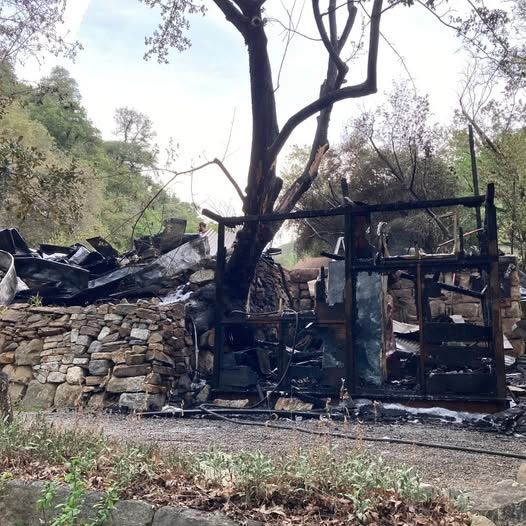
Image posted by Florence Caplow on Facebook
I have been at Tassajara through three fires. The first was in the summer of 1972 when the composting cardboard caught fire at the Flats. That fire was minor, successfully suppressed and led to increased awareness of the danger from fire at Tassajara.
The Marble Cone Fire in the summer of 1977, caused by lightning strikes in the Ventana Wilderness was a forest fire that threatened Tassajara.
The third was the original zendo fire that occurred during shosan in April of 1978.
Note: photos to be inserted below when they become available. (Haven't gotten Alan's photos, but including one above found on Facebook.)
This is about the recent demise of the Tassajara “temporary” zendo. Not sure of where to start, it seems like the elements of dependent origination that began way before — maybe over 2,000 years ago in India — ultimately caused the 2026 fire. The recent history of how the new zendo came to be built began the year before, in that hot, dry summer of 1977. What follows are impressions of a few events I recall from that time.
The beloved Tassajara zendo destroyed in the Spring of 2026 is gone after 48 years. A trusted friend, home and confidant to many. The original stone zendo was gone after 11 years in 1978. Is there a pattern here? How much impermanence, twisting our collective nose can we stand? Or, another side, to paraphrase Ryokan: the zendo burned, now we can see the moon. As one of the builders of the “temporary” zendo, I see it as an event of dependent origination— connected to everything and yet a single event. An applicable quote sometimes attributed to Suzuki Roshi is “ if it isn’t disappearing, it isn’t real.”
Thinking of the origins of the zendo, I reflect on the events of the summer of 1977, when Tassajara and the Los Padres Forest experienced the Marble Cone Fire. It was a very hot dry summer and we were aware of the risk of fire. Putsy (sp?), the local forest ranger, came into Tassajara several times to help us prepare for the eventuality that might come.
It was a difficult summer. With many guests, we were feeling understaffed, everyone working to the max. As one monk expressed it, “We go flat out to the Fourth of July and then hang in til Labor Day”- a good description.
One event that summer that stands out for me occurred when I was working in the shop. A fellow dressed in black came walking in and introduced himself as Black Bart. He had a sizable black truck, a black beard, and a black dog — and he was dressed in black. He introduced himself as a welder by trade and said his partner told him that he could change his karma by coming to Tassajara and doing something nice for “you folks,” like fixing something that needed welding repair. Many strange things happened at Tassajara in the years I was there, and this was one. Consulting with the director, Ed Sattizahn, we decided we should do our best to help this fellow by letting him repair something. Looking for the right object needing welding attention, we even considered breaking something he could weld back together. We finally decided that the chance of a random spark igniting a conflagration was too great, and that he should come back at another time when the danger of fire was not so severe. He accepted that determination and departed.
Soon after, in August of ’77 small forest fires from lightning strikes broke out in the Los Padres Wilderness. There was growing concern that they could reach the Tassajara watershed. Guests were asked to leave and preparations for a possible fire began. As the Marble Cone Fire drew near, by order of the Forest Service, Tassajara was evacuated. While we were preparing to leave, David Chadwick — a potential rescuer who had heard of the situation at the monastery — came speeding down the road in a borrowed 4x4 to see if he could help. Realizing there was nothing to be done except leave, he turned around and went back out.
Following Forest Service orders, we evacuated. I was the last one out and took the Gandhara Buddha from the zendo with me. Wrapping the Buddha in a blanket, I placed it behind the driver's seat in my van. Departing, I recall not knowing whether to close the gate or leave it open, and decided to leave it open. It felt strange and disorienting to leave Tassajara completely abandoned, but that was the plan.
As I proceeded up the road, the truck in front of me — an old green International, sent by Baker Roshi to retrieve his artwork — stalled. Without even getting out of my truck to see if the bumpers lined up, I pulled up behind it and pushed the green truck all the way to the ridge, from where it could coast. Driving out, heavy smoke and flames had reached the road at various points. Not knowing what else to do, we drove through. Scared, somehow we made it to Jamesburg.
Having successfully evacuated Tassajara we regrouped in Jamesburg and, after some deliberation, Baker Roshi decided to try to re-occupy Tassajara on the premise that the Forest Service would have to defend the monastery if people were present. The strategy worked, and with the help of a team of professional firefighters setting back-fires and making other preparations, Tassajara was saved.
The fire and back-fires cleared the slopes around Tassajara of vegetation. The exceptionally heavy rains the next winter produced substantial runoff; the monastery was affected in many ways. Until then, the main entrance — both for walking and driving into Tassajara — was over a bridge directly inside the main gate. I don't recall whether the bridge washed away or whether we removed it, but it was gone.
The entrance to Tassajara was relocated to the west, just before the main gate, through the creek when conditions allowed. The area on the west side of the side creek had previously been the Tassajara dump, containing used machinery and other debris. But we needed a dependable bridge. Unused items from the dump were moved to the flats, and we were able to use two large logs cut down on the ridge to build a new bridge. Ted Marshall maneuvered the logs into place using the bobcat. In the photo, you can see Ted, Jay Simoneaux, Howard McDonald, Clay Calhoun, Vanya Palmers, and me building the bridge.
(Include photo)
While working on the bridge, rain continued, sometimes intensely. I recall a moment when I was standing on firm ground at the side of the creek and then looked down to find, in an instant, that a mudflow had covered my feet and legs to about a foot deep. I couldn't quite believe the power and speed of flowing mud until that moment, when I understood how a mudflow can take a building off its foundation in minutes.
I recall standing on the bank of Tassajara Creek that winter, across from the old steam rooms, watching the creek rise until it began threatening to overflow its banks — scary moments we somehow survived.
The side creek that paralleled the road, now known as Cabarga Creek, received its name that year. In a meeting in the dining room, Tom Cabarga remarked on how a creek without a name could threaten to divide the monastery and cause so much trouble. If the bridge over the side creek washed out, Tassajara would be split into two camps. Cabin 4, the shuso cabin, was designated as a storeroom for supplies for people possibly stranded below the side creek if that happened. It was stocked with bags of rice and other provisions. Cabin 4 also had a bulletin board, and it was on that board that the plan for the new zendo was posted — a drawing now in the Zen Center archives. At that same meeting, Philip Whalen was moved to name the side creek without a name- Cabarga Creek. And so it was.
When Cabarga Creek overflowed, the five culverts in the first few miles up the road filled with debris or washed out entirely. Food and other supplies could only be brought as far as the top culvert, forcing us to hand-carry supplies over improvised stepping stones in the creek. Until recently, there were photos of this effort on the wall behind the stone office. Fortunately, a number of vehicles at Tassajara remained and could be used to ferry supplies the rest of the way down the road.
We decided it would be good to get the vehicles out so they could be used to pick up supplies in town. On a dry day when the creek was low, we began moving the vehicles up the road. What I remember of that day is that we made it over or through the first four culverts. At the fifth culvert — a sharp right turn in the road — we improvised a bridge. The last vehicle to pass was Tassajara's green Chevrolet Blazer, with Ted Marshall driving. As he cautiously moved over the embankment and bridge, both collapsed just as the rear wheels cleared. I have often thought that, despite all the calamities that have occurred, over the years, Tassajara has led a charmed and lucky existence, sustained by many good intentions.
Another event, largely unnoticed at the time, would have substantial consequences later. The water supply pipe carrying water from the springs down to Tassajara washed out that winter. We re-established the water supply by running a fire hose through the trees between the springs up the road and Tassajara. A good solution at the time — but what we didn't realize was that the hose, looping up and down from tree to tree, severely reduced the elevation drop, or “fall,” that produced the hydraulic water pressure that supplied the fire hoses at Tassajara. When the original zendo caught fire in April, there wasn't enough pressure to direct a effective stream toward the flames.
The Spring Practice Period of 1978 was eventful from beginning to end. In those days, sesshin was held once at the end of the practice period, not monthly as it is now. Sesshin ended and shosan was the final event of the practice period.
Shosan is an important ceremony when monks ask the Roshi a question reflecting what they are working with in their practice. I was somewhere in the middle of the line and hadn't yet settled on which of two questions to ask. I have often fantasized that my indecision contributed to what followed. I was in choki, the kneeling position, preparing to ask my question, when Joel Clark opened the rear door to the stone zendo and said, in a calm voice, “There is a fire out here.” We all turned to look. Joel’s head was surrounded by a bright orange glow.
People immediately began moving toward the side doors and out onto the walkway and lawn. I grabbed a fire hose and pointed it at the burning building. I recall feeling a unprepared to battle a fire in monastic robes. Virgina Baker was standing behind me and turned on the fire supply pipe. The flow at the hose was so weak that it barely traveled a few feet. Most people were unable to retrieve their shoes or sandals from the racks outside the door toward the kitchen. The main fire pump had been out of service for months and not yet repaired or replaced. The only working pump was a small floating pump, which was hard to start and ineffective. We stood and watched the zendo and office burn.
The Gandhara buddha was destroyed in the fire but after a few years was beautifully restored by the staff at the DeYoung Museum. I have had a recurring dream since that day, of grabbing the buddha from the zendo as I ran out. Succumbing to the recent fire, perhaps it can be reconstructed again.
In those days before modern phone and internet connections, the only phone at Tassajara was a crank model mounted on the office wall. To make a call, you picked up the handset and cranked the handle on the right side of the phone; an operator came on the line and placed the call you requested verbally. But the phone had been destroyed in the fire. It was a strange feeling to be living the reality of the fire and destruction of the zendo and office with no way to communicate what had happened to the outside world. Some hours later we managed to cobble together a working phone from miscellaneous parts and inform Page Street — and the world — that the zendo had burned down. Events grew stranger still when the next morning, a full 24 hours after the fire, a fire truck complete with firefighters hanging off the side and a siren blazing came roaring into Tassajara.
A large part of this story is the firewall between the kitchen and the zendo. The firewall, including a fire-resistant door, was a requirement imposed by the county when the kitchen was constructed. People at Tassajara were furious that the county would require this wall and the expensive door. The fire burned right up to that door and scorched it, but did not burn through — thereby saving the kitchen.
The following day we resumed shosan in the dining room. It was still my turn, but my question had changed. With clarity, I asked: “Why is it that it takes an event like this to remind us how much we love and need each other?” I think it was what many were feeling and don’t remember the answer.
Practice period ended and plans for a temporary zendo moved forward. I recall — perhaps not accurately — that a permanent zendo and Buddha hall had been in the plans for some years. The plan was for a zendo somewhere near the site of the existing original one, and a Buddha hall at a right angle to the creek. There is probably a record of this somewhere. In the meantime, the upper barn served as a zendo.
I recently saw a description of the original zendo as having a dirt floor. The zendo had been appropriately a bar with a floor of dark red or brown linoleum over wood framing. There were patched holes at the rear where the pipes for the previous bar sink had been located.
It was decided to build a “temporary” zendo in the southern section of the upper garden, where a two-story stone hotel had once stood before burning in 1948. Paul Discoe designed the zendo in a traditional manner, with the altar at the center. A drawing was posted on the bulletin board in cabin 4.
The layout was simple. The building was twice as long as it was wide, with entrances at the midpoints of the long sides, following a traditional plan — fifty feet by twenty-five feet. There was no foundation; the building rested on independent precast concrete piers. It was a modified post-and-beam construction, with posts spaced five feet apart, the infill conventionally framed with 2x3s and sheathed with plywood. The zendo was surrounded by a covered walkway, or engawa, five feet in width.
As word of the fire spread, resources were gathered to begin construction. It was gratifying, and felt deeply supportive to the community, to have others pitching in. The first to arrive was a crew of lean young carpenters from The Farm in Tennessee. Stephen Gaskin, leader of The Farm, had a warm relationship with Suzuki Roshi and Zen Center going back to the be-in days in Golden Gate Park in the 1960s. The Farm carpenters were practically indistinguishable from one another and worked with long-handled hammers with an axe head opposite the nail face. They were all business. I don't recall how long they stayed; they disappeared as suddenly as they appeared, having set up the floor framing and structure of the new zendo.
(See photo)
Paul Discoe, our under-appreciated resident genius builder, was in charge and had a clear vision of how the building would be constructed. With Paul and Jerry Fuller in the lead, walls were framed on the ground and tipped up. The lumber was inexpensive framing grade, sorted to show the best faces, but essentially rough-grade stock.
With the office destroyed, the substitute entry point for reservations and payment moved to the gatehouse. The original gate and gatehouse had been built by Ken Sawyer and Jerry Fuller in the early 1970s, and reservations were handled in Jamesburg. The office crew that summer consisted of Kathie and Norman Fischer, alternating child-care responsibilities, and me. My time off I spent continuing work on the zendo. After the siding came the ceiling and floor, both of plain cedar. The project ran with a great deal of volunteer labor — reportedly costing $15 per square foot.
A local Sikh carpenter came and went and helped considerably. Vanya Palmers was around for a while. Rick Fields showed up and worked a day or two on the zendo, as did Bill Shurtleff. I spent what felt like endless weeks assembling the engawa — there was so much of it. It was constructed of framing grade Douglas Fir, sorted to show the best boards. I used a typical diagonal staggered nail pattern on the engawa boards and reversed the direction of the stagger at the south entry. I figured I was probably the only one who ever noticed that the nailing was reversed there, and I enjoyed seeing those reversed nails on return visits. The roof was done in corrugated sheet metal. We painted the panels black to give them a more refined appearance. Having never installed sheet metal roofing — usually used for chicken houses and tool sheds — we managed to do it wrong, and it leaked the first season.
The windows were built in the city by Gary Tolson, a fine carpenter then training with Paul. The doors were built by Will, of Fourth Street Woodworkers. Jerry Fuller was there for much of the project. Jerry, a skilled carpenter and student of tea ceremony, built the bathrooms at the southeast corner of the zendo. The stone steps at the west end were built by the Tassajara stone crew, originally including Howard Dewar and John Nelson. Paul showed us how to cut a post tailored to fit snugly over an irregular rock and how to fit boards at the outer edge of the engawa tightly around twisted posts. The zendo was essentially complete by the end of the summer, and the Zen Center carpentry crew departed for San Francisco to begin to build Greens Restaurant at Fort Mason. I was the first to go to work at Greens, and I recall driving my truck through the opening that is now the main entrance to remove the industrial remains of the old carpentry shop that became the restaurant.
Toward the end of the Greens project, Jerry Fuller and I drove up to Crescent City to pick up the large redwood burls that became the large sculptured pieces at Greens. We delivered them to J.B. Blunk in Bolinas, who carved and finished them in his shop. Bringing the burl to Bolinas was an adventure. When loaded onto an old yellow San Francisco Board of Education truck, the weight of the redwood burls drove the truck bed down into the wheels so the truck couldn't move. A welder was summoned and proceeded to cut out the steel wheel wells to free the wheels. It was such an unusual load that whenever we stopped on the way back, people would gather and ask, “What are you going to do with that wood?”
We began construction at Greens in the fall of 1978 but were soon sent back to Tassajara to build the covered walkway to shelter zendo servers from the rain. That job lasted into December. It was quite strange to be at Tassajara during practice period and not part of the practice period. The crew finished the covered walkway and departed on the morning of the first period of Rohatsu. I remember loading tools and driving out to the sound of the han that morning.
(Include photo)
The office had burned with the original zendo. With the opening of Greens, the Zen Center family had become friendly with the Chez Panisse community through mutual admiration of good food. Deborah Madison, the first executive chef at Greens worked at Chez Panisse. During the summer of 1981, the crew that built the café at Chez Panisse came to Tassajara and framed a new roof over the office. Kip Mesirow was the contractor on the Chez Panisse job and led the office roof construction. Kip had been coming to Tassajara for many summers, first working on the courtyard cabins in 1975 with Gene DeSchmidt and on other buildings since. Before we arrived, Ken Sawyer had beautifully constructed forms, fitted to the shapes of the stones in the stone wall around the top of the wall surrounding the office. We poured the concrete for a bond beam in the forms and framed the roof.
Prior to the 1978 zendo fire, there was a storeroom behind the office. Rummaging through the ruins afterward, I found a singed cover of an old Wind Bell. I am including a photo of the cover.
(Photo)
The “temporary” zendo lasted 48 years. There is a Zen custom of mindfulness when passing through a doorway: one leads with the foot closest to the side of the door opening. Because the zendo floor was softwood, there was an indentation just inside the south door from wear — an unintended record of mindfulness practice accumulated over many years. I had planned to repair the floor on our next visit.
I have heard that the removal of the debris of the zendo is awaiting analysis of possibly toxic material in the ruins. The building had no plumbing and minimal electrical wiring. It was all wood and I cannot imagine what potentially toxic material might exist there.
Baker Roshi once told a story about visiting a mountain temple in Japan on a cold day. When he went to sit, he noticed the zabuton was warm. He pulled back a corner and discovered hot coals beneath it. When he remarked that this seemed like a fire hazard, the attending monk replied that yes, the zendo burned down every twenty-five years or so — and they rebuilt it.
Alan Block, Berkeley, April 20, 2026 (thanks to Wendy Pirsig for proofreading)