The Han an excerpt from What Happened at Tassajara
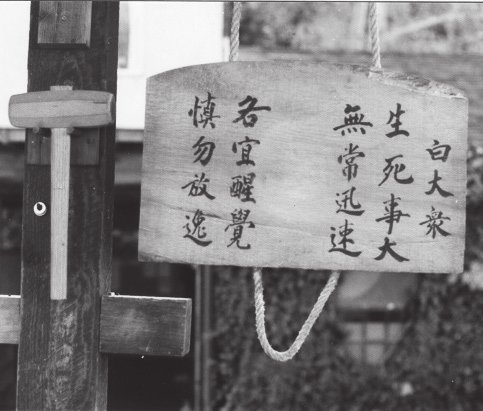
I told Katagiri I wanted to study the kanji of the Heart Sutra and other chants we recited. He suggested I start with something short and work my way up to longer pieces. He said the kanji on the face of our han was a poem traditionally written on the han at Eiheiji.
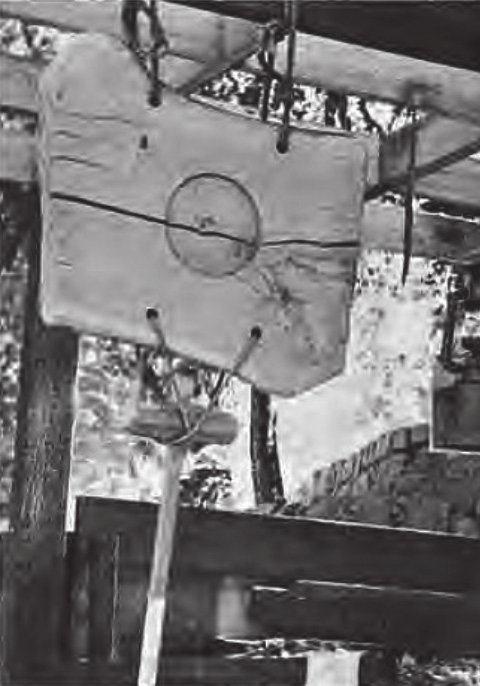
The han, the wooden board that called us to zazen, hung under the arbor by the entrance to the zendo. The mallet it was struck with dangled from a loop of rope attached to the bottom of the han. The person striking the han would gassho, take the mallet out of the loop, hold the loop with one hand to pull the han slightly toward them, keep it tight and strike the center with the mallet. In time, the mallet would dig a splintered crater into the face of the han. Eventually, the han would break in two. We heard that monks in Japan had a party when the han in their temple broke but we didn’t follow that practice at Tassajara. The original han that Paul made had broken and was replaced before it was a year old. Kobun had worked with Paul on the design of the next han and mallet. It was thinner and hollowed out some on the striking side to improve the sound. The mallet for it was hefty but with a thin handle. The handle wasn’t to be gripped tightly on impact any more than if the mallet head had been at the end of a string.
The pattern of strikes to call us to zazen took fifteen minutes. There were three introductory strikes well-spaced, then seven less than a minute apart from each other, ending with a roll down and a punctuating hit. The next round was five strikes, a roll down and two hits—light then strong. The third round was for the doshi, whoever was leading service. They’d arrive and offer incense at the altar with the final strikes: strong, light, strong.
I stood before the han not holding the mallet but a pen, copying the characters from the poem on its face. I wasn’t sure how to write all of them because Kobun’s brush work was so artistic.
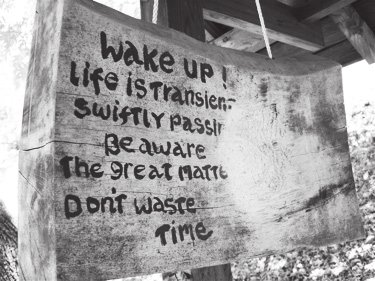
Han is just a word for wood, but not the one that’s used in modern spoken and written Japanese. It’s what the Japanese made of the Chinese sound long ago. It was common knowledge that han meant “wood,” but the meaning of the kanji on the han was not known. When asked what that poem meant, Suzuki had said, “Don’t goof off.”
I went to Katagiri’s cabin. He looked at what I had written, grimaced, and wrote the characters clearly on a blank sheet of rice paper while enunciating how they were to be pronounced. I told him I’d find out what I could about the meaning of those kanji and, if he would be so kind, I’d come talk to him about it later when I knew more. He nodded and gasshoed.
I had a stack of reference books bought in San Francisco. The one I used first was the large Nelson’s kanji dictionary. The regular Kenkyusha Japanese/English and vice versa dictionary was sometimes useful, but usually not. This was old stuff I was looking at. I had Chinese- and Japanese-to-English Buddhist dictionaries that were helpful, but not at all complete. Serious students of those classical Buddhist texts were beyond using books with English.
After going over the meaning of the kanji on the han in those books, I went to Katagiri. And after talking with him, I had a fairly good idea what the poem on the han said.
There were four lines with four characters each. The kanji in the first line were easy ones “life death thing big.” What comes across is more like, “Life and death is the great matter.” The next line had two compound words meaning something like “Transient, fleeting.” Then four kanji that meant “each of us should pay close attention.” The last line was tough. It started with “respectfully don’t be … ” All I could find for that last word was “dissolute.” But I didn’t like “Respectfully don’t be dissolute.” I considered, instead, “Don’t be lax.” “Don’t be negligent.” Katagiri suggested, “Don’t waste this life.”
After that, every time I heard the han hit, I heard those words in Japanese and English. Thump! “Life and death are the great matter.” Thump! “Transient, fleeting.” Thump! “Each of us should pay close attention to this.” Thump! “Don’t waste this life!”
Katagiri was resolute. He took those words seriously and he wanted us to do so, too. Surely, his assignment during the Pacific War had made him think seriously about life and death. He never saw combat, but he had abdominal surgery without painkiller. He was a seventeen-year-old kamikaze pilot who was out of a job when the war ended.
I also studied other short poems that we chanted, and some that we didn’t. Katagiri gave me a book that included these short Soto Zen chants called gathas. This book wasn’t like our books. It was about eight inches tall, four inches wide, and opened like an accordion. The whole thing was one continuous page that was read from right to left.
There was the robe chant we did in the morning, the Bodhisattva’s vow, and my favorite, the bath gatha. It was calligraphed in romanized Japanese and English at an altar at the entrance to the baths. It read, “Now as I bathe this body, I vow with all sentient beings to wash from body and mind all dust and confusion and feel healthy and clean within and without.” What I liked about it was how fluidly it chanted in Japanese. Kobun said to chant it to oneself, but I liked to hear it, so I’d do it softly so that no one would notice. People went in and out quickly so the entrance to the baths wasn’t a crowded place. When I stepped on the bridge I’d remember it and think, Oh boy, now the bath gatha. “Moku yoku shintai togan shujo, shinjin muku naige koketsu.”
One gatha I said every evening was my last thing before going to sleep. “Now as I sleep, I vow with all sentient beings, to awaken to all things without throwing off the world.” I thought it was neat that I vowed to awaken as I fell to slumber.
As an Amazon Associate Cuke Archives earns from qualifying purchases.