Interview with Mike Dixon
Mike
Dixon link page
Portrait of DC by Mike Willard
Dixon -
view on his website
Didn't date this but I can tell
that it's early by what I say - like not knowing who the first
students were. So I'd say 1993.
Mike's artist name is
Willard Dixon. His full name is Willard Mike Dixon. He's not
only a wonderful artist but gifted musician as well. He jams with
a jazz group. "Our quintet is called Studio Five. consists of sax,
bass ,drums ,piano,and guitar." He plays the sax.
This was an interview that's
really more of a conversation done sometime around mid 1994 I
guess. It was transcribed by Elizabeth Tuomi sometime back then
and edited by me 5/31/10 - DC
Mike did the cloud paintings at
Greens restaurant and the fly for Zen Mind, Beginner's Mind.
MIKE DIXON
In the long run, my own life, meeting Suzuki and following
the way he taught me, has colored everything. It's
something that continues. I feel now that I'm getting
older, more the pull into practice. It's different
now. In many ways it's a lot easier to practice
now. There's so much baggage that's gone.
(Tape 1, Side A) –
DC: What's your most vivid memory of Suzuki?
MD: Trying to remember when I first saw him.
Somebody at the Art Institute told me I should go over and see
this guy. I did go over. That was probably '62 or
so. I went and started wanting to go back. I had
this feeling you have sometimes that somebody's is a lifetime
friend. Or that someone is going to be very important in
your life. It's unexplainable, really.
It's hard to say exactly why. Some feeling of trust
there. And you trust your own feelings about that
person. He seemed so interesting. There seemed to be
so much attention of some kind there. It was something you
just naturally wanted to continue. As I was leaving, the
first lecture that I went to, I was walking down the stairs at
Sokoji, and just as my head got to about floor level I looked
through the banister posts as I was almost disappearing from
view ?? I looked into the room and he was looking right at
me. I told some stories that I wrote in the Wind Bell
anniversary issue – a lot of people were telling stories about
Suzuki. I mentioned a couple of interesting things in
there. One that I liked in particular. Every
Saturday we would clean up everything and sit three or four
zazens and lecture. I was sweeping away, and some new guy
came in. Usually I would just keep to myself and not be
terribly helpful to new people who were wondering what they
should do. This guy was looking around, wondering what to
do. I gave him my broom. Just then, I turned, and
Suzuki was holding his broom out to me. It seemed a
perfect sort of teaching.
DC: Maybe because there's such a physical component to it.
MD: Yeah. When I first started going I was living
down on Pierce Street and going to art school. I was
living with a guy I'd gone to the Brook Museum with. Trudy
used to come over on weekends. Eventually I took her to
see Suzuki, when we were still living over there. She was
very much into studying philosophy, and had studied at Wesleyan
and was continuing graduate studies at UC Berkeley. She'd
been studying Heidegger and Wittgenstein. She was curious
about it. I took her in there, we were staying toward the
back, and he talked for a while. Then he started talking
about philosophy. The study of philosophy, as opposed to
the study of Zen, or practice. He was always holding out
the idea of practice to us at that time. He didn't have so
many students then. As opposed to just thinking and being
curious about it. The idea of actual sitting practice was
different. He told a story about a philosopher he knew in
Japan who had killed himself. Just as he told this story
he looked very intently at Trudy, who was studying
philosophy. She went backward a few inches. It
seemed very relevant to her. Then we moved to a place on
Larkin and Pacific. We continued to go to lecture for
awhile. Then one day we got up and said why don't we just
start sitting, start practicing, and see what it would be
like. We did. And we continued. That was
probably '63.
DC: What was he teaching?
MD: It was practice. Zazen. To me that was the
essence of it. One time we had dokusan. He asked me
if I had any questions. I said zazen answers my
questions. He said, yeah, that's right. If there's a
pencil sitting here on this tatami, and all of a sudden it's
gone, one person will say, oh, somebody stole my pencil.
Another person will say somebody just borrowed my pencil.
I took that to mean that you can really only answer your own
questions.
DC: You have your own interpretation of things.
MD: Our mind, after sitting for some sessions, just
naturally calmed down. We would think about
enlightenment. What is it? Is it something we were
going to get? The idea of it. It seemed like the
more we went on, the more we wondered if there really was any
such thing. Suzuki used to say things like, on my second
enlightenment ??
DC: He didn't say that later on.
MD: I remember him saying things like that. Like you
might have a small enlightenment here, or a larger one later, or
you might have many enlightenments. That was my
feeling. That is my own experience and I think that's
true.
DC: Ananda said that Suzuki always maintained that he
wasn't enlightened.
MD: Well, if you say you are, you aren't. But you
can't say that you aren't either. You don't say that you
are, and you don't say that you aren't. Suzuki told me
once, he said, "I knew a farmer in Japan who was just like a Zen
master. He was a natural man, a simple man, but he was to
all intents and purposes a Zen master. The only difference
was that if you said to him, you are a Zen master, he would say,
no I am not." He had a kind of innocence. You would
have to go through a lot of stuff to come out the other side and
say, "Ah, so desuka," (Is that so?) or something like
that. Or not to deny it, not to claim it.
DC: The subject of enlightenment is what I want to deal
with precisely because we never have. It's something that
hasn't been discussed much in Zen Center history. I don't
particularly like to talk or think about it. It seems sort
of sophomoric to do that. But Ananda brought it up first
thing. "First and most important. Suzuki Roshi was
not enlightened!"
MD: I don't know what he meant like that.
DC: I called him up last night and got him to talk about
it more.
MD: I think he was beyond enlightened or not
enlightened. To think about that is to miss the
point. And I think that was Suzuki's teaching. We
don't want some fancy idea about practice, or some excessive
experience. The point is just to see things as they are in
the moment and not to attach to things, to let things change as
they go, and let them come and go out. That's more
interesting than being enlightened. As soon as you become
attached to any enlightenment you might have had, it will be a
barrier to you. People who talk about it that way are
asking for trouble.
DC: Helen Tworkov wrote an editorial for Tricycle in which
she talked about how Zen Buddhism in America is developing and
at a crossroads. Sort of therapeutic, socially
responsible, and is forgetting about enlightenment which is the
first goal of Buddha. That's how Buddhism began, with his
enlightenment under the Bodhi tree. She said Suzuki Roshi
never talked about it. I mentioned that to Michael Katz
and Michael's read all the lectures several times and listened
to them all and he said, oh no, he talked about enlightenment a
lot. But subtly, maybe. He sure didn't emphasize the
sort of enlightenment you hear from people who were going to
Yasutani. Or working with Maezumi. Or with Tai
San. To quote Tai San, there's only two types of
people: those who know and those who don't. My god,
if he's an example of those who know ?? that's so
ridiculous. There's a whole mind field of bullshit.
MD: Especially when you get into ?? when you get in some
position over other people. His teaching was so focused on
not being caught by anything or attached to any particular idea.
DC: I studied at this Rinzai temple in Japan. It
would have been impossible for me to get into it like
that. They were going after enlightenment and all
that. I like sitting and having sanzen (dokusan) and not
doing too much. I was on a totally different trip from
everybody else. But the teacher was so cool, he didn't
care. If he didn't care, nobody else cared. It was
partially because of who I am before I came to Zen Center, but
partially because Shunryu?san knocked it out of me and Katagiri
too in that Soto trip. It's controversial in a sense in
the Zen world.
MD: As soon as you sit your enlightenment is there, stuff
like that, all the time. You hear that enough you begin to
believe, that's right. Which, on the other hand, doesn't
mean ?? and Suzuki said one time ?? that you shouldn't just sit
on the steps and play your guitar all day. Meaning that
you don't just give up and do nothing because everything has
Buddha nature.
DC: I think a quote from him is, "Everything you do is
right, nothing you do is wrong, yet you must still make constant
effort."
MD: I would have the feeling, in sesshin especially, but
it was there all the time with him, that you would think you
were putting out this huge effort. You didn't have much
more to give. But just by looking at him you would feel
that you'd just barely started, hadn't even scratched the
surface yet. There just seemed to be this infinite well of
intention or effort that was under there somewhere. I
think our whole thing about enlightenment is, in a way, a kind
of ?? he used to talk about candy. He'd say it's OK to
give young students some candy, so they would get involved here
and get going on something. But really, you have to be
careful about that. Like selling intoxicating liquor is
the same thing. I think a lot of it has to do with
building up the intensity effort. It's the effort which
does lead to a kind of breakthrough. Enlightenment is not
something that you get. Enlightenment is realizing
something that's already there. It's more like getting rid
of, than getting something. I think that's the big mistake
that everybody tends to make.
MD: They think they're getting some experience from
outside that they never had. When you build that kind of
intensity of effort that you can experience in a sesshin it
tends to strip away stuff more than anything else. Then
you're just left with yourself. That's enlightenment, I
think.
DC: He also didn't like us to sit too many sesshins.
MD: He didn't seem to like us to think that that was more
important than everyday life.
DC: He was Apollonian. (v. Dionysian). Ruth
Benedict. Dionysian was more like the way I was, more
extreme. Apollonian was more steady?state.
MD: I think of Apollonian as coming from ?? emphasizing
harmony, rational. Dionysian is more concerned with the
dark side and with passions and working through that. I've
always felt that Suzuki had a tremendous well of humor,
too. He had such a powerful presence that even though he
was a good speaker and knew a lot about the history of Zen and
Dogen, it didn't seem that was his sole effort to me. He
would often say things to that effect. Emphasizing the
practice. One time in the early days a bunch of us were
sitting in Sokoji. There were only about 15 or 20 that sat
regularly. We'd been sitting ?? and it was very intense in
those days because we were finding our way and we didn't quite
know what we were doing. I don't think Suzuki knew quite
what he should do with us either. One morning we came in
and we were sitting ?? like a Saturday and it was the second
sitting, and all of a sudden he was talking up at the altar and
his voice got low. All of a sudden he jumped up really
quickly and started hitting us all with the stick. He just went
around the whole room just one after the other, very fast.
He'd never done that before or anything like that. It was
accompanied by this tone of voice which almost seemed like he
was mad at us. He roared around the room hitting us and
boy did that wake us up in some way. As a group.
Later he said something about that, and about the fact that he
felt that something was wrong. He didn't know quite what
it was, something about our attitude. The way we'd been
practicing was not right. That we were all doing something
a little off that he felt needed correcting.
DC: He did the same thing at Tassajara years later.
MD: One time I said something to someone else, that I
thought in the early days my experience was that there was
something about it that seemed particularly intense or difficult
at times. He heard that and he jumped right on it and
supported it. Yes, that was really true. When we
first started sitting there was something going on that was ??
in my own mind it was finding our way ?? something that made it
particularly intense at times.
DC: This included who?
MD: Betty Warren, Della, Trudy, myself, Dick, Bill Kwong,
Phil Wilson, Norm Stiegelmeyer, Graham, Paul Alexander, Fran
Keller. And then Mel (64) and Ed (66) came a little
later. Ed and his brother Dwight. Mel was living at
one point with Dan Moore ?? the visionary ecstatic poet.
Used to smoke a lot of dope. A lot of people did.
Mel moved into his house. Mel played
recorder. Mel taught me how to read music. I got my
flute and we used to play music together and I learned how to
read with him. That was before he came to Zen Center. I
think Dan Moore brought him to Zen Center.
DC: I remember Dan Moore coming around later. What
about Daniel Eggink Remember him? Very
intense. I heard he was the first guy who shaved his
head. He was sleeping in a car in Big Sur that got hit by
a car and almost died from that and came out of it a little
weird. He was involved in drugs. Super
intense. Ended up having a nudist/guns commune in
Montana. Everybody walked around nude and they had a lot
of guns. He seemed slightly dangerous. What about
this guy Bill McNeil? Some guy early on, I think he went
to Japan and really didn't like it and quit. Maybe he quit
in '62, '63.
MD: Must have been before my time. Wasn't Bill the
first guy who went & sat with Suzuki?
DC: I've heard that. I've also heard Bill say that
Paul Alexander was there when he came. Bill is one of the people
who really took the Zen thing seriously. He's still doing
it. It's hard to get in on his schedule. He's very
sweet. He goes every year to China. He really
believes in it.
MD: I haven't been up to his place. I want to do
that. I haven't seen Bill for years. Phil Wilson
really disappeared. He burned his robes I hear.
DC: Dan Welch did too. Reb wrote Dan a letter.
Dan sent him back the ashes. He's gotten over that.
In fact, he and Dick just went to Japan and Europe together.
MD: One thing that happened between Suzuki and
myself. I don't think I've ever told anybody. In his
office one time, I was facing away from him and he said, "You
know. You have to be my successor." My blood went
cold. I pretended that I didn't hear anything. I
left the room. I thought about that for awhile. I
never mentioned it to him and he never mentioned it to me.
I figure he probably tried that out on a lot of people.
DC: He said to me once that we'd be starting temples all
over and people would be going out and Zen Center would
spread. He said I should go to Texas and start a temple in
Texas. I said no I'm not going to Texas to start a temple.
MD: I have the feeling now that he was just putting out
feelers for possibilities in those days, who was up for
it. And I definitely wasn't. I was trying to be an
artist and the idea of leading a Zen thing, or even having any
responsibility beyond a certain point was not what I wanted.
DC: Maybe he wanted to see which direction you were going
to go in. The lay direction or the priest direction.
I think one of the things that upset Ananda about Zen Center's
development when we got Tassajara was the shift from lay
community to priest?led community with hierarchy and more rules
and ceremonies.
MD: Yeah. I think Ananda always felt it should have
remained small ?? kind of like it was in the beginning. Go
on like that forever. All the stuff that happened because
of Dick somehow got off the track. Somebody used to say ??
I don't know if it was Ananda ?? that Suzuki himself felt that
way eventually. I don't know if that's true or not.
DC: He'd say things like Zen Center's getting too
big. I don't know what to do with it. Peter
Schneider told me that Suzuki would say let's just you and me go
off.
MD: In my own mind related to that story I told you about,
that I'd never realized before. It must have been about ??
when we lived in Mill Valley ?? must have been '65 or '66
. He gave all of the old students a rakusu. They
were the kind you order from Japan. He had this little
ceremony and he gave everybody in the original group one except
me. I'd been sitting longer than some of those guys.
Dick got all pissed. He said, "How come you're not giving
Mike one? What the hell's wrong with him?
DC: I would have been so hurt.
MD: I was cool. And for some reason I wasn't hurt
particularly I just thought it interesting. Trudy went in
with everybody else. I wasn't even there. They all
got their rakusus. Trudy's was blue, like the ones we make
now, but it was bigger. It looked machine made and had a
big circle on it. I was wondering what was going to happen
on this. Trudy said, "Suzuki asked me, ‘What did Mike
say?’" I knew that was coming up so I was cool. When
she came in with her rakusu, before she said what Suzuki said I
just said, "Oh fantastic. Congratulations." I did feel
very nice about it. I didn't really care, but I was sort
of wondering. Then later she said that Suzuki had asked
what Mike had said. "So I told him, oh he gave me a kiss,
and said 'This is great, Trudy. I'm so happy for
you.'" So that's what he got back from me.
DC: Were you sitting with the group at the time?
MD: Yeah, of course. I did everything. I was
treasurer.
[This is a mystery to me DC
- See this info at the bottom of the
page.
DC: Typical Zen mind fuck, man. I would be so
jealous if people who came after me got ordained.
MD: You could say, well, I'm special. I didn't get
one. I could go on that trip if I wanted to. So then
later when he was getting on in years and I thought well, I want
to get a rakusu from Suzuki. I want to get my name from
him. All the other guys got names. Trudy was Bai Ho
Sesshin ?? Winter Plum blossom. I just told somebody that
I wanted to make a rakusu. That was when we were at Page
Street.
At some point when I knew an ordination was happening I said I
wanted to sew a rakusu. I was the leader of that group,
the head student. I bowed and said, "Please accept
us." And he said, "Yes, I will." So he wrote on the
back of my rakusu. My name is Ko Kai.
What would your idea be about what Ko Kai means?
DC: Ko Kai could mean something ocean. It could mean
dark ocean.
MD: I'll tell you what he told me it was. When he
was dying I went up and talked to him and I asked him, what does
Ko Kai mean? He said it was Out of Kalpa Camellia Tree.
(discussion of calligraphy on Mike's rakusu)
MD: Dick said the camellia is called the guillotine flower
and it's like death because it all of a sudden falls off.
Suzuki said the name was something very old that just comes
out. It seems to be one of those things that's very open
to interpretations.
DC: I'm sure this is the same ordination I was in on.
MD: Do you remember me leading it? You were already
ordained. I just waited around until I thought, well, he's
going to die soon, I've got to get ordained. It was an
ordination before he was sick.
DC: It's interesting that he would single you out for
that. It's just a personal thing between you and him.
DC note: 7/2020 -
I was lay ordained in the summer
of 1970 and the next one was summer 1971. These are the first
since 1962 as far as I know.
MD: But then I thought ?? because I told you that story ??
that he was just giving me what I wanted. He told me there
had to be a successor and I didn't even answer him. So why
should he give me a rakusu? He figured, he doesn't want a
rakusu. And he was right.
DC: Oh, god, maybe that's it.
MD: I just finally figured that out.
DC: Suzuki talked with Silas and various people.
Dick became his successor because he was the one who had
demonstrated the ability to that beforehand. Plus ?? and I
talked to Suzuki about this ?? Does this mean he's enlightened
or something? No no, just means he has good
understanding. Don't make too much of it. He said
also, full commitment. He saw he had the organizational
and fundraising ability so he seemed like the right
person. But people who say that he was given that just
because of his administrative ability ?? that's
ridiculous. That's not enough.
MD: As I told you on the phone, when we had that election,
he became president by one vote, I missed it by one vote.
I think I probably voted for him. I think he took it as
kind of a mandate and he just took over. From that point
on he was gangbusters.
DC: Was this the point where Bill left?
MD: Bill was still around.
DC: Bill has told me that story in great detail. How they
had an argument over who would hit the bells. Suzuki had gone to
Japan, the first time – 64 or so – and asked Bill to hit the
bells and so he was hitting them all and Dick said he should
share and Bill said no he asked me so Dick called a meeting and
Bill said he couldn’t take the conflict and started sitting in
Mill Valley except for Saturdays.
MD: It didn't happen immediately, the changes to ZC when
Dick took over, but you just look around, from that point on he
changed everybody's consciousness about what we were doing, what
could happen, what was going to happen. Plus we're getting
Tassajara next month, then we're going to do this. He had
a whole agenda.
DC: I heard Dick talk about Timothy Leary once. He's
sort of like Leary. He said a lot of people had taken
psychedelics, not millions, but many people had had psychedelics
of different types. Leary thought LSD is going to change
civilization as we know it and helped to make that happen.
This entire vision came with it. Terrence McKenna
(mushrooms) said Leary is a completely unspiritual person.
MD: He just saw it as a chemical aid to living. He
wasn't thinking about spiritual things.
DC: To me he was somewhat. I read Leary's stuff
before taking LSD, and I considered him to have a very
responsible attitude. Fast, meditate, prepare yourself,
have a guide, take it, and go for the clear light. That's
the way I took acid. I thought that was great
advice. And Richard Alpert, the spiritual one, was telling
people to just take it and not be afraid to go romp around and
have fun. Anyway, that’s the impression I have.
So Dick got that job. He realized he had a hot product
there.
MD: He realized there was potential there. He was a
great organizer ?? the poetry conference at UC Berkeley.
That was right down his alley. If he wasn't doing what he
was doing he'd probably be president of GM or something.
DC: Movie maker. That's what he told Bob Beck he'd
like to do.
MD: I've spend years defending Dick in various ways.
Especially after the great debacle. A lot of people think
he's some horrible rapacious person, which he's not at all.
DC: He's got his problems but ?? he's still doing that Zen
thing. Ananda says Dick got exactly what he wanted.
He said Dick always said he didn't want to be head of a large
organization like Zen Center. He just wanted to work with
a small group of people. That's what he's got now.
MD: Better for him. I think that's what he
needed. But he thought he wanted a giant ?? Green's and
all ?? and he was socializing so much. It was getting
ridiculous.
DC: I feel that his socializing was part of his vision for
world change. That he basically wasn't that much of a
social person.
MD: And when Brown was in on all that it was hard not to
think that if you weren't there you were not at the center of
things. When the Governor was coming around, it was really
looking like this is it.
DC: It really had a strong element of hubris: pride
cometh before a fall. It got top heavy.
MD: He got caught by it. My feeling was that when
they called him on it, eventually, he was surprised. He
was rocked by it. Like he had no idea what he was doing.
DC: His life style had diverged so sharply from what he
was encouraging people to do in his lectures and dokusans.
It was unsupportable.
MD: It's interesting, knowing him so well, that he had to
go through all that. Very heavy stuff. And come out
where he is now. I think he had to just cut of everything
here. He just felt that all that was gone or lost.
That everyone in California thought he was horrible.
DC: He thinks that the only reason for him to come to
California is so people can throw tomatoes at him.
MD: We aren't talking about Suzuki. But we are in a
sense, because everyone sort of wonders, why did he pick Dick?
DC: That is a frequent question. Some people will
say it was a mistake.
MD: I feel the same way you do. I have a feeling
that he wanted to do it. He was there. He's
smart. He has a good understanding. Personally, I
think he did a lot of great things.
DC: He was part of a great period of experimentation.
MD: He made this whole thing happen which is still going
on. If all this hadn't happened, I wouldn't have Green
Gulch to go sit at right now.
DC: I'm looking at Suzuki Roshi's life. What did he
do in Japan? When he died he left all these places.
But it's not just him. It was him interacting with America
and some particular Americans and what happened there.
Without Dick and Graham and you ??
MD: I don't think Suzuki was ambitious for all that
stuff. I think he had some feeling about having a
monastery. I think he had a humbler vision. He
seemed so unambitious most of the time. He seemed
ambitious in an inner way. If you were there as his
student ?? and he would accept any student ?? he would be
incredibly sincerely open and involved with that person in a
real way. He would be there in every possible way for that
person. That's pretty ambitious ?? spiritually
ambitious. But not in the sense of getting bigger.
More like deeper.
DC: But the time at which he arrived, '59, giving him
until '66 to improve his English and get a good base ??
historically what better possible timing could there have
been. The time was one of enormous curiosity, looking to
the east, looking to non?materialistic practices. Maybe if
Dick hadn't have been there, the nature of the situation, there
might not have been a real impetus to achieve that level of
activity.
MD: Something else would have come along. I remember
we did the Zenefit to raise money. Big Brother, Gary
Snyder ??
Side A, Tape 1 ends.
Side B.
DC: Alan Watts gave a great talk.
MD: Suzuki walked forward on the stage and just opened up
his arms like that. Do you remember that? There was
a great cheer, a great yell from the assembly. He just
smiled. Just opened up his arms like that and just
radiated to everyone. It was like the guru ?? people were
eating it up. It went along with the music and the whole
consciousness raising thing. Everything that was going on
at that time. I don't remember him saying much of
anything. He might have said a couple of words. That
was the event. When he was actually up there in this rock
and roll situation doing that. It was surprising for me to
see because usually we would just be alone at Sokoji or
something.
DC: The other time I can think of was the big Be?in where
he sat up on stage with Alan Watts ?? Ginsburg. I remember
going with him, and I think it might have been Loring Palmer who
took him. I think Dick took him on a peace march once.
Do you remember him talking about Japan? Or telling about
important childhood experiences.
MD: One thing he said about Japan ?? He said in Japan we
just accept our role, what we're doing, and we tend to just do
that. But in America everybody thinks they have a choice
about everything. If I don't like this, I can do
that. He was talking about it in relationship to the
practice of Zen, that it caused us some problems, because it
kept us from committing. We always thought, well, if this
doesn't work out I'll just do something else.
DC: I've never totally accepted his trip on that ?? or any
Japanese person's trip on that because it's so strong.
It's a clash between Japan and America, not just Zen and
non?Zen. I was talking to Hoitsu about somebody that
wanted to get transmission from him. I was presenting it
to him in a non?prejudicial way. And he said, "Let them
get transmission from Mel or Reb or Les or Bill." And I
said well this person is sort of a peer of those people, and was
very close to Suzuki (his father) and that's why they're
interested. And he's not on particularly good terms with
those other people. And he'd say, "God, you Americans are
always talking about 'my way,'" My way is this, my way is
that. I want to do it my way. In Japan nobody thinks
about my way. There's the stream of practice of Buddhism
that we throw ourselves into. We follow THE way. It
really upset him.
MD: There's something about the spirit here that induced
him to stay here and start practicing with people here.
Something about the openness that he appreciated and wanted in
his students. He said a lot of the Japanese people here in
America ?? he was working at Sokoji as their priest ?? are not
interested in sitting. In Japan nobody's interested in
sitting anymore. That's why he was here. He was
interested in practicing, and he wanted to be with people who
were interested in practicing.
DC: He would go back to Japan and tell them that Americans
are great and really sincere and want to practice and are
interested in Buddhism. Even now in Japan ?? older guys I
was interviewing about Suzuki ?? they would say, "In America you
practice Buddhism with your head. Here we practice with
our body." They come with this superficial dichotomy
trip. The same things we used to think back in the
sixties. East inclusive; west dualistic. East
both/and; west either/or. They tend to do that. They
have a lot of set ideas about that. They tend to think
that Americans can't study Zen. There's no way to get
ahead in a Japanese system. People who go from here to
there to study anything will study awhile, but ultimately it has
to do with being Japanese and almost nobody gets anywhere with
anything they do. He was not unique, but rare in his
ability to leave his culture behind and work with
westerners. As far as Ananda is concerned, to transcend
Japanese Zen.
MD: Being willing to change it. Although he seemed
very faithful in many ways. At the same time it was
changing just to fit us. To make is understandable,
workable, practical.
DC: I think he had to continue to stand in the robes that
he'd grown up in and in the Buddhism that he'd been
taught. He couldn't go too far astray.
MD: He said it was important to have rules. A lot of
Americans' idea of freedom is no rules. He wanted to
disabuse us of that idea. So he had to emphasize quite a
lot in his lectures that rules were important. The rules
in practicing Zen are not just to have for the sake of rules,
but are the way that we become free. You can turn somebody
loose on the piano, and they can think they're very free, but if
they don't know how to play the piano they're not going to be
able to play music.
DC: Witness your painting. It's about following
rules that you create something beautiful, wonderful to look at.
MD: The freedom comes within the form. Americans,
especially young Americans at that time, had some problem with
understanding those ideas. Why do we have to sit hour
after hour in this rigid position?
DC: And then later when we got Tassajara, why do we have
to go to bed at this hour? There were a lot more specific
things where you were being treated like a child. To me
being treated like a child is a typical thing of Japanese
culture. And then you can have your freedom. Like in
art, they teach you exactly how to do everything, and all you
can do it copy everybody and do it the way they've been doing it
??
MD: That's interesting. The idea is that if
everybody does the same thing then you can see how everyone is
different.
DC: At a certain point you can go off and be free.
There's abstract calligraphers and everything happening in art
in Japan. But the road to getting to that level ?? once
you're up there there's no restrictions at all.
MD: Often those people are doing something that looks very
traditional, but if you know the tradition, and know the other
artists who are masters, you can see how different they are from
one another. Like playing shakuhachi. I've been
studying that for five or six years now ?? learning how to read
the music. At the beginning you just have to play those
notes one after another, and it's rather a difficult instrument
so there's nothing else you can do. You can't even get a
note out of it for awhile. Eventually your breath becomes
more and more efficient and you get stronger, and then you can
start doing more expressive things. You just play the
music the way it's supposed to be played and you will be playing
it in a very personal way whether you're trying to or not.
Everyone has a different way of breathing and a different
approach. It's our nature.
DC: I used to write a song every day. At least
one. If I felt like it or not. One of the ways I'd
write a song is I'd hear something I really liked and I'd try to
write something just like it. Invariably I'd come out with
something that was to me better than average and different from
what I was trying to copy. I found that to be a really
good way to do something. I was just reading something
like that too. Somebody ?? Mark Twain or Oscar Wilde or
somebody ?? saying that if you have the creative urge that it
can't be taught or learned, it's just there. and it can't
be suppressed. The person with the creative urge would
create original things ?? all you have to do is let them
go. Tell them to copy other things. It doesn't
matter. It will come out. I've always tended to
think that everybody has creativity.
MD: That's more Buddhist idea about it. As opposed
to this idea that we have more or less of the genius, or the
gifted ones, the inspired one, who is different from everyone
else.
DC: At least in Japan they have this idea of the national
treasure ?? the great Zen Master, the great poet, the great
artist ?? I almost feel that we have ideas here of
limitation. Their idea over there is that you're
unlimited, it all depends on how much effort you make. We
have the idea that you're born with a certain amount of talent.
MD: In Japan it's like the genius of effort. It has
the genius for putting out extraordinary effort. That's
why so much is achieved. I sometimes think about art in
general and people who are create ?? it has to do more with
sticking to it and going on with it. Whatever the ability
is in a person that allows him to become involved more than some
talent for putting the paint on or whatever ?? that that's the
most important thing.
DC: That's the 99% perspiration and 1% inspiration.
MD: Well, that's not right either. In music there's
undeniable talent that comes out in people at young ages.
There is something called talent and it's undeniable. But
at the same time there's this other thing where a person who you
might not think has a lot of talent has a lot of interest and a
lot of something that leads him to produce some very interesting
stuff. And then there's the person who has only the
willingness to work and no talent at all and no matter how hard
he works never comes up with anything.
DC: It's hard knowing the laws of art. How much is
nature, how much is nurture, how much is effort. I can
remember, in terms of music, having definite ideas about what I
liked and what I didn't like as far back as I can
remember. 4 or 5 years old. Stuff my mother
played. I didn't like the schmaltzy crap. I didn't
like overproduced band music that was too undefined. I
didn't like things that were too silly. As far back as I
can remember just from what I heard I had definite tastes.
MD: I liked Leadbelly more than Glenn Miller.
DC: Although I liked Glenn Miller. I tended to not
like big band stuff as much as ensembles. I'd like a
string quartet better than an orchestra. I had a definite
taste. In movies, songs, rock and roll. Almost
genetic or something.
MD: Getting back to Suzuki. Somebody told me that he
was always taking millions of naps. Have you heard that
much? A lot of naps in the afternoons. In the early
days, even before he was sick. Maybe he needed to.
Not that there's anything wrong with it. I suppose us
Puritans here in America might think you should be working or
something. He seemed to be free from those kinds of petty
ideas completely. Simultaneously, he was very free and
relaxed. At other times he would be somehow evoking this
incredible effort ?? from you and from himself. But he did
seem very relaxed most of the time.
DC: Terribly relaxed. Terribly at home with himself
and the world. At ease and comfortable to be with you
whoever you were. And he did take naps. But he’d get up so
early.
MD: One time I took him over to some lumber yard ?? some
big work yard in San Francisco. We drove into this place
and we went into this little house where they hang out.
There were 3 tough working men in there. They were talking
about football and swearing and carrying on. Suzuki just
swaggered in there and started talking about football. He
had his robes on. I'd never heard that tone of voice
before coming out of his mouth. At some point they started
looking at him, like, who are you? We somehow got our
boards and left. I remember watching him another time ?? a
woman came in and did tea ceremony for us. She did about
20 or 30 teas. It took like 3 hours or something. We
were just sitting there watching her. At the very end he
said, "Instant tea." While the woman was making the tea he
was watching her in zazen position, and he was so into watching
her. His hand would be moving a little with hers. He
was totally out there. Interesting to watch.
I remember him
talking about his teacher sometimes, and the tremendous feeling
of gratitude he had to his teacher. Not his father, but
his teacher. He told when he realized ?? a story about
when he did something that was unthinking and unconscious.
It was his monkey mind showing. He was so ashamed of
that. At some point he realized something ?? had a
powerful realization ?? and felt this overwhelming feeling of
gratitude toward his teacher. Tears were coming out of his
eyes and his nose and his mouth. He finally realized what
his teacher was trying to do. Why his teacher had been
hard on him at times. What his teacher had given him.
DC: I don't want to sound too cynical but I really think
the Japanese are programmed to have that experience. I've
heard so many Japanese people tell me ?? one of Suzuki's kids
will tell me about their experience with him ?? which wasn't
much fun. He was aloof and busy with other people and just
barked at them and didn't pay any attention and never touched
them and didn't listen to them and left them. His first
wife was murdered by a monk whom he insisted on keeping in the
temple. But they all say, I'm so grateful to him, cause I
realize now that blah blah blah.
MD: Do they have to tell that to themselves to make it
alright?
DC: They rationalize everything bad that happens to
them. Every hardship is rationalized in terms of a kind
teaching. (In looking at Suzuki's teacher) ?? I can't see
much there. Sort of strict disciplinarian. I don't
think he taught much zazen. Just doing services and being
a temple priest. It's great to be able to squeeze the good
out of things.
MD: I certainly had the feeling that it was more than that
the way he described it. When you look at Suzuki, if you
knew him, you had to feel that it was more than all that.
His teacher must have been something special ?? someway.
DC: I'm not convinced that So-on was so special. I
think Suzuki was special . . . Do you think that for Suzuki to
be special he would have had to have a special teacher?
MD: I don't know. If you look at it traditionally
you'd have to think so wouldn't you? Otherwise he'd be
like that farmer. That farmer Zen master who doesn't know
he's a Zen master, and if you say he is, he would say he was
not. To actually become a teacher in a formal sense and
take students, especially as a Japanese, you need certification.
DC: But you can climb on the shoulders of your
teacher. You can be greater than your teacher. Dogen
said that his master was the first truly enlightened teacher in
500 years. So he would have to have been more special than
who came before. So-on was a guy that yelled at the
neighbors and intimidated people around his temple. He was
a feared person. He was a fierce landlord. The
temple owned a lot of land and there were a lot of farmers on it
that had to give a percentage of what they grew to him. He
looked at it and said they weren't giving enough. He was
like a feudal landowner. He was taking care of the
temple. But the temples were important institutions that
had land, and were supported by people. The temple priest
was a great person, someone you would look up to, somebody above
the other people. This was broken up by the government
after the war – and before the war too. Buddhism was
suppressed during the war because Shinto became stronger.
Shinto was more in line with the goals of the militarists.
They were drafting the priests; Buddhism was on a
shoestring. It didn't have the nationalistic possibilities
that Shinto did. After the war they took land away from
the shrines and temples both to sell them to the people
cheaply. Buddhism lost out there too. It seemed to
me that So-on's reputation is one of being gruff and
aloof. Suzuki was aloof with his family but friendly with
neighbors and members of the temple. Everybody liked him.
He had a strong social conscience and at least after the war
talked about peace. And before the war too. He started a
kindergarten because he wanted to help revitalize the culture;
to get kids into a Buddhist school.
MD: I see him almost as a kind of adventurer.
Someone who was willing to leave his wife and children and come
over here; call them up and say he's not coming home. He
had the ability to go as far as he had to go to accomplish what
he wanted to accomplish. He wasn't restrained by any
bourgeois concerns. In that way he seemed like an
artist. He would say things that art and religion are the
deepest expressions of human nature. Art was right in
there. He had a tremendous respect for art and the people
who made art. So even if I didn't want to become a gung?ho
Zen instigator or organizer, I felt that I was still OK with
Suzuki because I was an artist. I never got any message
from him of, "Why don't you stop painting so much and come over
here and help run Zen Center?" I never got that feeling at
all.
DC: I think he was an adventurer. It's hard to see
that when you look at him in Japan because it's hard for anybody
in Japan to do anything but their duty.
MD: That's why he wanted to come over here too, so he
could be somebody different.
DC: He tried to get out at other times. He tried to
go to China during the war. He went over there and had to
run back.
MD: So there was something about him that was out of the
ordinary as a Japanese, and among Japanese that led him to want
to come over here and change himself.
DC: I think he was out of the ordinary in that he wanted
to get out and go somewhere else. There's so much security
in being Japanese ??
MD: Why did he want to do that? He wanted to explore
different parts of himself.
DC: I think that's true. The idea that Suzuki Roshi
was a great person in Japan, who had a great enlightenment and
great enlightened teachers, and wanted to bring those great
enlightened traditions is so romantic or something.
MD: But when he came over here there was nobody.
DC: He didn't have any students there. Ananda said
that the only time Suzuki got mad was when he said that to some
younger students at Zen Center. Suzuki called him up and
said, "What's this you say about I didn't have any students in
Japan?" Ananda said he was just repeating what Suzuki had
said. But he was sensitive about that. And his son
makes that point so strongly to me. Politics.
MD: So he was totally free when he came to America from
all that hierarchy. He would bring Japanese people
over. Or he'd go over and check in with them. Let
them know what was going on. But then he'd come back here
and do his own thing.
DC: There's another thing that affected his life more than
the hierarchy. He was head of an important temple with 200
sub?temples. He had 500?700 families, and that's what took
up his time. He was pretty free from hierarchy because
they have a pretty loose system. He hadn't chosen to be
involved in the big systems of headquarters in Tokyo. But
the amount of time he had to spend taking care of temple
obligations with these families was prohibitive. Non?stop
funeral, memorial services. That's what he wanted to get
away from. I only heard that from one person in
Japan. I had to make an appointment with a neighbor of the
temple through somebody who lived across town because the Suzuki
family didn't want me to talk to the neighbors. I had to
talk to the neighbors going around their backs. I'd tell
them I was doing it. They'd say, don't disturb the
neighbors. They're so nervous. I love Hoitsu, I love
his wife, but if you get out of their stream of things, get out
of what's accepted, it starts making them nervous. This
guy who lived below the temple said that Oh yeah, he used to
come down here all the time, sweeping the road, he'd come down
and tell me, "I've got to get out of here."
MD: So if you see Suzuki coming from that, coming over
here by himself with the excuse of taking on a small Japanese
congregation, and then getting involved with all these hippies,
and ending up on the stage of the Avalon Ballroom with Janis
Joplin ?? that becomes an interesting image. It makes him
look like a wild west cowboy. I would assume that would be
pretty damned radical to a lot of old priests back in
Japan. Unimaginable. That's how he's an
adventurer. Like these guy who decide they're going to
kayak down the entire west coast of the United States.
DC: Mitsu, Okusan, talks about hippies. What was the
sociological breakdown ?? you say there were 15 key people ??
would there be 5 or 10 coming and going?
MD: When we were pretty filled up there was about 10 and 4
or 5 in the back ?? usually anywhere from 2 to 10 other people
would be coming and going ?? or more ?? and more who would just
come to lectures. There might be 40 or more at lectures.
We started taping the lectures at some point. I remember
going through that routine. I don't remember what
year. Before '66, I think. Dick could tell
you. [July 1965]
DC: Dick and I are on good terms. He's really into
this. He's already outlining my book – suggesting
things. We're closer now than we ever have been. He
appreciated the support ?? Dan Welsh and me going there during
the first practice period. I just sent him the definitive
pictures of Suzuki's father and the guy before that. That
was a painting. The others were photographs.
Reproduced for the book, for Zen Center. I also got their
photo albums from Japan to America and had the best pictures all
photographed.
MD: I always did have the feeling that there was a hidden
part to Suzuki. Something mysterious. Where it was
all coming from seemed mysterious. He had so much
commitment and drive of a certain kind. Unusual. So
you couldn't help but think where does he get it?
DC: He was always there. If he wasn't sick he'd be
at zazen.
MD: He seemed constant, but not in a negative sense.
In a sense of faithful to something. He would often talk
about the inmost request. Remember that? That we had
to listen to and respond to our inmost request. It seemed
he did that in some way. My experience, during sesshin, of
people, of layers, was getting down to something like that,
where the sincerity of that the meaning of it, became uppermost
in your mind or your feelings. The depth and the levels of
that that seemed possible in his presence seemed almost
limitless. I sometimes I wonder how much we project our
own best nature into all this though. That's part of the
game, I guess.
DC: I'm not a firm believer in there being some truth,
like one truth and one story, to Suzuki, that I can look
at.
MD: I think you should be doing the Rashomon approach
here.
DC: That's exactly what I see. What type of book do
you think would be best about him?
MD: I think just that would be fascinating: to have
everyone's point of view, and just put them all out there and
let the reader draw his own conclusions. What else is
there?
DC: Dick could do a book that was his point of view.
And I think he should. And he can have a say in this
book. I'm going to do it the way Japanese bring things
into their culture: they don't homogenize them. They
don't stir things up. Everything's separate. So you can
see Dick as Dick, Mike as Mike, etc.
MD: And not try to cross?reference all this stuff and
correct everything for them. Even if there's actual
mistakes in there, you could just let them stand I
suppose.
DC: I could throw in a correction right after in
parenthesis.
MD: It's appropriate for a book about Suzuki, or anyone
like that, to have all these different points of view.
It's so Zen that way, so appropriate.
DC: I pretty much have to because I don't have opinions
about a lot of things. I don't want to have to be
sensitive and profound about a lot of things that I don't feel
that way about.
MD: I think that'll be fascinating, to hear everyone's
feelings and thoughts about it.
DC: Michael Katz, my agent, and I are talking about this a
lot. There is a strong contingent that wants a straight
biography where the process is invisible. I'm willing to
try that. And I don't mind trying it as part of the
process of doing it, but I think it would be pretty boring.
MD: I think if you work the biography into this thing,
then you could have both. That would be the best. If
you try to be as objective as possible about laying the facts
out about his life, then we can all draw certain conclusions
from that that are different from opinions. If you know
these are facts and you put them out there without
editorializing too much about it, then we can draw a lot of
conclusions about him just from those things. That he had
all these commitments in Japan and then he came over here.
Those are facts. There are conclusions that most of us
would draw from these various facts.
DC: There were commitments to the Japanese congregation at
Sokoji that it didn't bother him at all to drop. [I don’t see it
that way later] He and Katagiri both resigned and went over to
Page Street.
MD: It wasn't a huge group there. They could easily
get somebody else. He didn't have any problem with that.
DC: Did he ever disappoint you in any way? Were
there ways that he didn't come up to expectations?
MD: Sometimes I would think he was rather
buffoonish. He'd act clumsy sometimes. Not in a bad
way. Nothing that worried me. One time when I told
him that Trudy had died (in the hospital) ?? I think perhaps I
should have called him before she died, or at the time she was
dying, if that would have been possible. I didn't know
when she was going to die. I think he might have liked to
have been there. When I told him that she had died he was
very emotional on the phone. It almost worried me.
But when he came to the hospital he was completely in control
and more his usual self.
DC: How was he very emotional?
MD: His voice was cracking with emotion. He was
making a very obvious effort to control himself. I'd never
seen that side of him before. It disturbed me, because I
didn't know he was like that. A picture that goes with
that, is a picture of him later, sitting on the altar, and
separating her ashes with chopsticks, one by one. Part of
her ashes went to Wyoming and part stayed here. He looked
at each one and would say, "Beautiful ashes."
DC: Is there anything else you could say about Trudy?
MD: Her working on Zen Mind, Beginner's Mind was a very
satisfying thing for her to have been able to do, the kind of
thing she always wanted to do. Her philosophy had been
leading up to it, and her interest in writing and everything
else. It all came together with her intense interest in
Suzuki and Zen. She had a chance here to accomplish this
book which has grown on to be a very significant thing for a lot
of people. She did it right at the end of her life.
She and Suzuki became quite close. That's probably why he
was so emotional when she died.
DC: He said at her funeral he'd never hoped to have that
good a disciple.
MD: She had a real way?seeking mind. Even before she
met him she had that very strongly. When she was young she
had . . . quotations from thinkers and writers ?? trying to
distil everything down to some truth. Then her study of
philosophers. It all went to Suzuki. I encouraged
her a lot toward Zen and awakened philosophy. . . .
DC: The idea of philosophy for me is so boring and
tedious.
MD: I used to know some of these guys in Berkeley.
They were pretty . . .weird. There was one of those
guys that Suzuki told us about, he was going to commit suicide
over there ?? I don't know if he did ?? mad philosophers getting
so overwrought ?? trying to figure everything out would put you
over the edge.
DC: In my particular case, I tried to read philosophy in
high school, college, I just couldn't follow it. I'm
just not constitutionally capable ?? something about attention
span ?? but when I read Zen stuff...
MD: Dick used to be interested in some of that and he would talk
to us about Heidegger. Dick would get a Heidegger book and
skim it or get a summary, and then that was Heidegger.
Trudy would consider that very half?baked understanding.
DC: I admire somebody that can skim it or read a synopsis
and come up with a little world?view ?? I couldn't even do
that. I'd forget it. Way?seeking mind ?? he used to
talk about way?seeking mind. It would be interesting to
make a list of key things he would bring up like way?seeking
mind, grandmother mind . . .
[Tape 2 Side A]
DC: Grandmother mind was his interpretation of kind mind,
one of Dogen's 3 minds in his Tenzo Kyokun, instructions to the
cook. I felt like I had complete permission not to get
involved with the complexity of things. Not to have to
figure out what all the philosophers said. Not to have to
even figure out what Dogen was saying.
MD: You'd just get hung up on it. Why bother?
DC: I really wasn't interested. I did, however,
study Dogen and Sandokai in Japanese and I studied it with
Suzuki and other Japanese priests. But I was just doing it
for something to do.
MD: Remember when he would be expounding on the Blue Cliff
Records? Bru Criff Records? That could get a bit
tedious, I must say.
DC: They're thinking of publishing the Sandokai
lectures. There are disagreements if it should be done or
not. Peter Schneider pointed out that his lectures on
particular texts were not as interesting as the general
lectures.
MD: He'd get sort of technical. You'd have to
interpret everything. It seemed so obscure to us.
He'd have to go to great lengths just to make it barely
understandable. Then he'd start talking about what it all
meant. Seemed kind of tedious. But he always ended
up making it kind of interesting ?? at the end. He seemed
very interested in it all. He had a side of him that was kind
scholarly.
DC: Definitely. He studied with Kishizawa. But
the more I look into it in Japan, I can see our tendency to
exaggerate and idealize things. Some of that comes from
Dick. Dick is Zen Center's primordial exaggerator.
MD: He's a mythmaker.
DC: Right. The idea that Suzuki was a close disciple
of Kishizawa Roshi? not quite. So-on Roshi was his first
teacher and Kishizawa was his second and he worked closely with
him and studied with him for thirty years but he wasn’t a
disciple. He'd go once a month and hear a lecture. I
think Suzuki was important to Kishizawa. They did big
ordinations together ?? 400 people at a time. They were
revitalizing Buddhism. He was inspired by Kishizawa.
He was more than a scholar. He was a Shobogenzo
scholar. But also he was into zazen and practice with an
emphasis on Sandokai. He's got 300 pages of lectures on
Sandokai. Sandokai is the meaning of unity and
multiplicity. We chant the text at Zen Center. It
came in in 1969 with Tatsugami's arrival. I think there's
stuff in there of interest. But I think it would be a
great disappointment to bring it out the way it is edited at
this point.
MD: Regarding Zen Mind, Beginner's Mind: I was busy
making my paintings. I was not so involved. When we
moved to Mill Valley we stopped going to zazen every day like we
had been in the city for years. I was getting more into
art and less into Zen at that point. She and Dick would
meet and talk about it. She would work on it. She
went over the original tapes to some degree. She would
talk to Suzuki a lot about it. She talked to him about
particular points in the lectures she wanted to clarify.
She went non?stop on it with a real intense interest and
involvement.
I'm pretty sure that was when were when we were in Mill
Valley. She already had cancer and didn't know what would
happen next. Hoping it would go away, but it was slowly
getting worse. She had breast cancer. She was going
through intense stuff ?? my trying to help her by fasting and
being very thin. Diets. Eventually the
hospital. I tried to keep her out as much as possible as
she preferred to be out and could do more things. But it
got more and more painful. I don't think she was into all
that when she was working on this. She had a
respite. The book came out in '70 and she died in '69.
So she was working on it in '68 and '69 probably. My
memory for dates is real bad. I don't remember her talking
to me a lot about it though I'm sure she did talk to me about
it. I don't remember things like that very well. It
was very satisfying for her to do the book and it brought her
closer to Suzuki. I remember being at Tassajara when she
was quite sick. She had trouble moving around. We
were all in Suzuki's cabin. She was lying there. She
seemed very happy to be there, with him. He seemed happy
to have her there. That was just at the end. I on
the other hand was getting kind of weird dealing with it.
I was getting fed up and impatient. Emotionally confused
about a lot of things that were going on. Difficult
time. She seemed quite calm. The whole experience
was rather intense and quite inspiring. Interesting.
DC: Did Angie come here?
MD: She was in Mill Valley. She helped take care of
the kids. I sent the kids back to my parents at one point
because it got impossible and they were willing to take them on
for awhile. Then Angie and I just took care of Trudy
together. Eventually just me. It took quite a lot of
doing ?? cooking and carrying her around a lot to various
events. Carrying her out to the car and carrying her into
a restaurant and stuff like that. She got lighter and
lighter. But her spirit was great. She became a
lightning rod for a lot of people. People would come
around and get whatever they got out of the experience. It
would happen that people would bring a lot to it. She
could just be herself, and they would take something away from
it. She wrote quite a lot of poetry toward the end of her
life which was quite good. I've got it someplace.
Maybe you can look at it.
DC: One thing I've got in mind is archiving, so that has
no limits to it. Something like that would be good.
MD: That would be good to get out there in some way.
Some of it's really good.
DC: Zen Mind Beginner's Mind is the magnum opus of Suzuki
from one point of view. Everything he said that's recorded
can be divided into Zen Mind Beginner's Mind and everything
else. That's a lot because of Trudy's work. She did
a great job. Everybody wants to come up with a book that
other people love. There's hardly anything like it.
MD: I've met people from time to time who have told me
that the book has saved (seized?) their life. And twice my
son Will had been trying to get into college, or something, and
Zen Mind Beginner's Mind will come up and he's had the
opportunity to say well my mother edited that book. We
can't help but think it helped Suzuki to accomplish what he
wanted to accomplish.
DC: Definitely in this book I should tell the story of how
Zen Mind Beginners Mind came about, so any details that could
make that story more interesting.
MD: I think Dick could give you the best information on
that.
DC: Here's a Dick story: Why did Tassajara come
about? Well, Suzuki's original idea was that everybody
would just have their jobs and come sit at Zen Center and
practice in the city. But he was disappointed because
nobody but me got it. That's Dick's explanation:
nobody but he could practice in the city. And because
nobody could practice Suzuki wanted to find a place to practice
in the country. Not only does he say this now, he said
this back then. I almost think I remember him saying it in
front of Suzuki. Dick did a lot of outrageous things that
people didn't like him for, but he tended to do them in front of
Suzuki.
MD: To test things.
DC: He got a tremendous amount of support from Suzuki.
MD: But was it Dick's or Suzuki's idea to get Tassajara.
DC: Dick says it was Suzuki's, that he needed the place to
work with people closer because it wasn't working in the city.
MD: I remember hearing something to that effect.
That Suzuki did want something like Tassajara where he could get
away and work with people. I don't know much about
that. I was always trying to get away from having to take
a lot of responsibility at Zen Center. So I was just happy
to go mail out the goddamn mailers. Graham and I were down
there doing that. And I designed a couple of posters for
benefits.
DC: I have the impression of Graham having been somebody
that Dick modeled himself after.
MD: They were quite close. The story I heard from
Dick was that Graham was a hopeless alcoholic.
DC: I know Graham very well. I see Graham these days
and he is a hopeless alcoholic.
MD: At some earlier point in his life, before he got into
Zen, Dick said the doctor looked at him and just said, you're
through, you're dead, he was so bad. Then he became like
the drill sergeant. Graham was the toughest guy who never
moved and always sat in full lotus, back straight as a
ramrod. He was Mr. Tough Guy. That went along with
being an alcoholic. If you have that tendency, perhaps you
have to be extra strict so you won't start drinking. He
was a very inspiring figure. He seemed able to tough out
any sesshin without complaining.
DC: I talked to Graham recently. He lives in
Healdsburg now. I used to see him in Japan. He and
Dick were very close, but their relationship fell apart when
Graham went to Santa Fe to help him with the restaurant.
MD: I was there and saw them both there while he was
working on the restaurant. I saw them working
together. I didn't see any fights or anything.
DC: Dick would say that Graham was drinking too much to be
effective. Graham will say Dick was too crazy.
Graham would be happy to speak with Dick again, but there was a
definite falling out.
MD: Some people just change, like that, when they
drink. I've never been around Graham.
DC: He's not a person who has a radical change, but he
tends to drink a lot. It's amazing he's still
drinking. He was talking to me about dying. He felt
like his life was over about 6 years ago, he was so dissipated.
MD: That's so funny. You see a guy who seems so
strong in Zen, and then he's like that. He was making such
a big point about being tough. Too much. Interesting
to look at people and how they turn out. Suzuki told an
interesting story about ?? there's a group of people walking
along a stream. Everyone's looking for the best
pebble. Some people are up in front and they're searching
very intensely, running forward. But there are a couple of
guy in the back who are just enjoying the day, laughing,
talking. One says, "Oh, what's that?" And pick up a
pebble. He didn't want people to get caught by that and
try too hard. He looked the cucumber. His teacher
always called him the third cucumber ?? the one that's all bent
up.
DC: Crooked cucumber.
MD: Sometimes they also refer to it as third
cucumber.
DC: I plan to call the book Crooked Cucumber.
MD: And the horses. That's a great story. The
one that runs when he just sees the shadow of the whip.
The one that runs when he feels the whip on his skin. The
one that runs when the whip strikes him and the pain really
sinks in. The last horse only runs when the whip sinks
into the marrow of his bones. He would say that doesn't
mean that the first horse is better than the second horse or
that the second horse is better than the fourth horse.
It's all the same, really.
DC: I look forward to finding what lecture that's
in. In your life as an artist, is there anything you can
say about what you learned from him that you've applied?
And what you didn't learn? And what other things you've
learned since then? How does he fit into your life?
MD: I continue to sit. I've been doing that since I
started 30 years ago. I mostly sit by myself. I
combine it with shakuhachi playing, quite often.
Occasionally I go and sit with a group and recently I've been
sitting with Ed at Green Gulch, one?day sittings. I like
the way Ed has changed over the years, and I feel kinship with
him. He's very relaxed about everything. He gets
more out of people that way. I enjoy sitting with Ed and
the group that he has. A lot of beginners like to go
there. I mentioned earlier, before Trudy and I went to
start sitting, and just were going to lectures, in my own mind I
felt the words were ?? that I was going to blow over in the
first windstorm. That's the way I felt. I felt
vulnerable. I wanted to do something about that. I
wanted to feel less vulnerable and more solid, more
grounded. I wanted to feel less vulnerable to the
winds. My study with Suzuki and practice with him has made
me feel more rooted, more stable. I have quite a few
mental problems in my family. That might be part of my
desire ?? You read about people who got deeply involved in
spiritual communities, then wake up one day and realize they
have no life, no children, no wife. I'm glad that I didn't
(get so involved), because at a certain point I was really
torn. I couldn't figure out if I should be a full?time Zen
monk or an artist. I was having a terrible time figuring
that out. The life style seemed so different. One
seemed so strict, the other not. I was going back and
forth trying to sit on two chairs at the same time.
Finally I decided I should be an artist. As soon as I
decided that, everything got cleared up, and I didn't feel tense
any more. I was more relaxed about it. I could do
art first, and then I could sit. I could still sit.
The other way around would have been hard.
DC: There's something perverted about the idea of
full?time Zen. It's such a strong idea, such a strong
feeling that people have to grapple with.
MD: Or just helping in a community. There's a lot of
work to be done. Older people have to have all this work
to do for others.
DC: Is it for others, or is it for an institution that has
a life of its own? You have to spend all your time
updating the mailing list in the back room.
MD: But I'm glad that Zen Center's still around.
That I can participate with the group if I want to.
DC: It's a matter of balance.
MD: In the long run, my own life, meeting Suzuki and
following the way he taught me, has colored everything.
It's something that continues. I feel now that I'm getting
older, more the pull into practice. It's different
now. In many ways it's a lot easier to practice now.
There's so much baggage that's gone.
DC: I find that I have less frenetic energy.
MD: Yeah. Impatience, distractions. Much
easier to just sit there and have a little peace and quiet.
DC: What other things have you brought into your life
besides art and Zen? Have you been influenced by any other
teachers, teachings, readings?
MD: Other teachers would be art teachers. Fred
Martin was an important teacher for me, at one time the director
of the Art Institute. I haven't sought out other religious
teachers. I occasionally think about it. Sometimes I
used to sit with Mel, too. Sometimes I sit with Ed.
That seems what I'm looking for there. I don't feel the
need to search for other groups.
DC: Or there's the search for the great teacher.
Many people are doing that. There's a guy named John
Tarrant, a Zen teacher in Santa Rosa who's a really neat
guy. He's an Aitken student. He writes good
stuff. He's very clear. Andrew Cohen is interesting.
I’ve suggested they invite him to speak at Green Gulch.
MD: Michael Wenger was thinking about asking me. I
can't talk to a bunch of people.
DC: The reason I'm doing it, even though I don't want that
kind of role, is that I think it's good for it to be spread
around.
MD: You can do it too. You could always just read part of
your book.
DC: I don't want to do that.
******************************
Mike Dixon on the phone October 10, 1994
DC: (I told Mike of Ananda's point about Zen Center moving
from a loose lay community to a priest trip and Mike said that
that might have been Dick Baker's making as much as
anyone.)
MD:
"Without Dick, it might have stayed very much the way it was and
Zen Center might not even exist now. The year he became
president, probably 63 or 4 or something, I lost by one
vote. And he just started doing everything. He had
all these ideas and eventually I found myself (in 66) down in
the basement sending out 15,000 fund raising brochures to raise
money for Tassajara. Dick stated talking about how we could be
priests and we could be masters. He was the first guy to
have that idea as a possibility and we all thought he was nuts.
DC: "Did you see SR as having an unattainable status?"
MD: "Kind of. I don't think that most of us ever
thought beyond the fact that here he is and we're studying with
him. It's not like he was a God, but we didn't have the
idea that we could be like that, or something."
DC: "That's exactly the difference between Reb Anderson
and me. From the moment he arrived at Zen Center he was on
a crash program to get enlightened, be a priest, be abbot,
become a Zen master and all. I was there for a good
time. But Reb and Dick also had an element of devotion,
they were strongly devoted to Suzuki. Anyway, before I was
ordained, Reb brought me to his room at Page Street and lectured
me on taking ordination seriously, realizing that I was
embarking on a new course, leaving behind the lay world,
becoming a role model, an example for others. We were
worlds apart. I understood what he was saying but I had no
interest in it. Now I think maybe he was right. I
had no business being ordained as a priest. I was just
doing it to be closer to Suzuki, and there was that to it at
least at the first. But when I was ordained he was clearly
dying, Katagiri suggested we postpone the ordination, and I
strongly insisted we go through with it - I think that made a
difference as my fellow ordainees were less assertive than
me. I did not trust the future and I wanted the status of
priest, disciple of Suzuki sealed. So I was ordained
partly out of ambition and I think there is an element of that
to ordination. But the ones with greater ambition went
farther, and maybe so it should be. Silas once said that
Zen masters are people who, among other attributes, wanted to be
Zen masters. So the point I'm getting at I guess is that
Zen Center must have been shaped not only by the vision, plan,
ambition and intention of Suzuki but by the same of his
disciples and students - especially Dick Baker whose vision was
fairly clear.
MD: "Well I was thinking about being an artist, thinking
seriously about that and going to art school and was terrified
about taking responsibility in the Zen thing even though I was
really interested in sitting and being with Suzuki. I
didn't want to be running things and was really glad that I lost
that vote and didn't have to do so much - though I did become
treasurer and I think I was vice-president - I didn't have to do
much and I really didn't want to. I just wanted to sit and
be there with him. But Dick had big plans right from the
beginning - well he'd been around for a while so he'd probably
been working up on it. I always had the feeling that
Suzuki just went along with it. Like, oh okay, let's do
that but if it hadn't of been for Dick I don't think those
things would of happened."
DC: "Do you remember Suzuki wanting to get a place in the
country or anything like that - where did that idea come from?"
MD: "Well I don't know. I don't remember him talking
to the group about it but maybe he talked to Dick or some other
guys about it - I don't know. Hmm - as a matter of fact I
guess I do have some vague memory of him wanting some kind of a
retreat, some kind of place where he could get away and do that
kind of practice. So I wouldn't be surprised if he did
have some idea like that and maybe that is what lead to
Tassajara."
DC: "Who wanted it more, Suzuki or Dick?"
MD: "I don't know, I just remember events and feelings
that relate to me.
Trudy had studied Philosophy at Wellesley - Heidegger and
Wittgenstein. I took her to see Suzuki and it didn't take
her long to latch on to that. Heidegger had supposedly
read D.T. Suzuki at one point and had said that if he understood
correctly what he'd just read it was what he'd been trying to
say for the last fifty years. I'd heard about Suzuki
through an art student who said this is a really interesting guy
who you should go check him out and so I went over and heard a
lecture and thought he was really interesting thought at that
point it was hard to figure out just what he was talking about
because he didn't speak very good English. And the whole
idea of Zen was pretty far out to us in those days - not too
many people were talking about things like that."
DC: "When was that?"
MD: "That was in '62."
DC: "And his English still wasn't that good."
MD: "You could understand him but it certainly wasn't as
good as it got later."
DC: "It sure got good later in the late sixties and till
he died."
MD: "More than the English it was just some of the
concepts - the whole thing seemed very impressive and exotic but
to me personally it was more his presence than anything he was
actually saying that made me want to be around him and know
him."
*******
Here's an email I sent
Mike in July of 2020:
Mike -
Something I didn't bother you with was what you said about (in
the podcast chat we just had), Trudy getting lay ordained and you
not. From Your 1993 interview:
MD: In my own mind related
to that story I told you about, that I'd never realized
before. It must have been about ?? when we lived in Mill
Valley ?? must have been '65 or '66 . He gave all of the
old students a rakusu. They were the kind you order from
Japan. He had this little ceremony and he gave everybody
in the original group one except me. I'd been sitting
longer than some of those guys. Dick got all pissed.
He said, "How come you're not giving Mike one? What the
hell's wrong with him?
From Crooked Cucumber:
On the last day of
the sesshin, at a lay ordination, students who had practiced
with Suzuki for over one year received precepts and a Buddhist
name. Yamada had brought fifteen rakusus , which turned out to
be the perfect number. One by one, in order of their arrival at
Sokoji, people came forward to receive their cloth rakusus and
lineage papers--the names of the ancestors dating back to Buddha
written on rice paper, folded, and placed in a rice-paper
envelope with calligraphy by Suzuki on the front. Betty and
Della were the first in line (Jean was in Japan). Grahame and
Richard were last, having arrived just over a year before.
That
early ordination was in August 1962 at the end of the sesshin.
As far as I know, the next lay ordination was in 1970. If
you'd been there longer than some of those who received them,
you'd have been practicing since at least 1961 August.
Trudy's not on the list of
those who received rakusu in the 1962 Wind Bell. But you've
got so many details in the story it's obviously a good memory.
But the details from what you said don't match anything I
find. You say you were treasurer then.
From a 1962 Wind Bell:
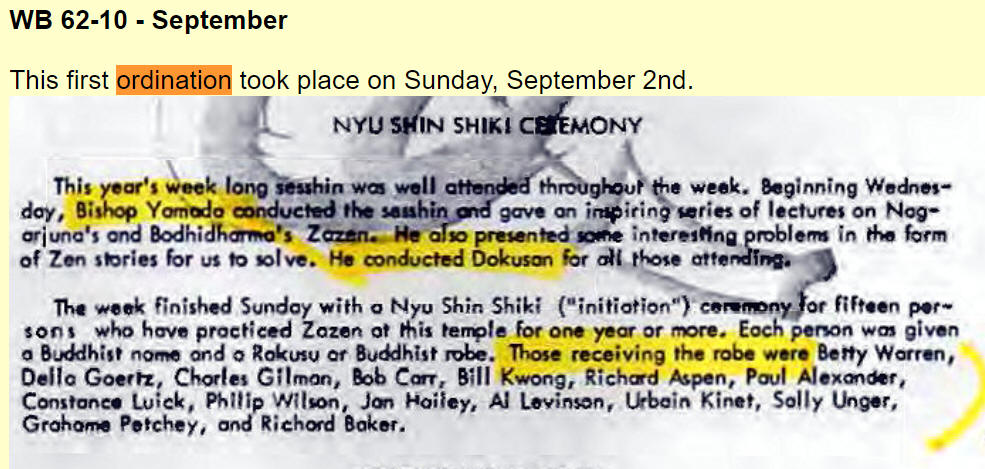
Right now it's all just a minor mystery and it's okay to leave it
that way. I just wanted to let you know in case you can clarify
anything.
David
|